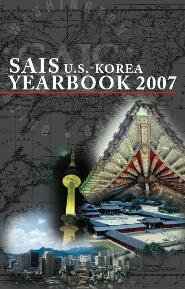
2007 U.S.-Korea Yearbook
 |
| | Tweet
Published on June 22, 2007
| Tweet
Published on June 22, 2007
 2007 was a year of extraordinary “big deals” on the Korean peninsula. Following the difficult 2006 that saw North Korea testing its nuclear weapon and difficult negotiations over security and trade issues with Washington, the Republic of Korea (ROK) made remarkable diplomatic breakthroughs on many weighty issues. But these agreements face challenges of ratification or implementation, and much work remains to be done.
The 2nd Edition of the SAIS U.S.-Korea Yearbook covers principal developments, including these “big deals.” The Yearbook is the product of SAIS’s Fall 2007 course, “The Two Koreas: Contemporary Research and Record.” Each chapter was researched and written by SAIS students based on in-depth readings and study. Additionally, as a part of the course, students conducted field research in South Korea, interviewing numerous government officials, think tank scholars, NGO workers, academics and private sector experts.
The 2007 Yearbook is divided into four parts: U.S.-ROK Relations, U.S.-DPRK Relations, Korea in the Region and Korean Politics.
Download the 2007 U.S.-Korea Yearbook in PDF format
SAIS U.S.-Korea Yearbook Table of Contents
Introduction
by Jae-Jung Suh, Associate Professor at SAIS
Part I: U.S.-ROK Relations
ROK-U.S. Alliance Adjusts to New Realities, by Samuel Yim
Yim, a former U.S. Army officer who served in Korea, reports on the transformation of the ROK-U.S. alliance through return of wartime OPCON of ROK soldiers and developments in the base relocation plan for the U.S. forces stationed in South Korea.
U.S.-ROK Alliance: Looking Toward the Future, by Ting Xu
Xu, a graduate of Beijing Normal University who worked in advertising and development in China, Japan and the U.S., writes about the future of ROK-U.S. alliance.
Korea-U.S. FTA Faces Uncertain Future, by Andrew Anderson-Sprecher
Anderson-Sprecher, who is currently a trade consultant in a Washington, D.C. law firm, examines the uncertain future of the KORUS FTA and its political complexities.
Part II: U.S.-DPRK Relations
The “Teeth of Diplomacy”: U.S.-DPRK Relations and the Six-Party Talks, by Rian Jensen
Jensen, who previously worked in Washington, D.C. on various security and political reform issues in Asia, surveys the Six-Party Talks and assesses prospects for continued progress in U.S.-North Korea relations.
No Doors Open: Displaced North Koreans and Asian Geopolitics, by Yumi Kim
Kim, a graduate of Princeton University who worked for several years in public service and non-profit organizations, examines the uncertain legal status and treatment of displaced North Koreans.
After North Korea: Rebuilding the Hermit Kingdom and the Transformation of a Command Economy, by Tania L. Askins
Askins, who worked for Salomon Smith Barney/Citigroup in New York, in their infrastructure finance group, analyzes the economic conditions of North Korea and possible scenarios for change and future development.
Part III: Korea in the Region
Small Blast, Explosive Effects: Roller Coaster Inter-Korean Relations, by Michael Yo
Yo, who interned at the Korean Institute of Defense Analyses, reports on the political, economic and cultural aspects of inter-Korean relations of the past year from the nuclear test to the summit meeting.
South Korea-Japan Political Relations in 2007: Roh and Abe’s Path to Estrangement, by Nat Kretchun
Kretchun, who has experience studying language and conducting academic research in both Korea and China, examines Korea-Japan relations over the past year with a particular focus on the effects of historical memory on contemporary relations between the two countries.
China-North Korea Relations, by Mathias Hartpence
Hartpence, a graduate of McGill University in Canada who has worked in both public and private sectors in China, writes about diplomatic relations between Beijing and Pyongyang, within the context of the the reengagement process that the Six Party Talks witnessed in 2007.
Sino-DPRK Economic Relations: The China Model’s Role in the Hermit Kingdom, by Benhan Limketkai
Limketkai, who has worked in the financial sector in San Francisco, reports on North Korea-China economic relations and the detrministic role that the interaction could have on North Korean economic reform and development.
The Dragon Next Door: Republic of Korea-People’s Republic of China Relations, by Jason Cohen
Cohen, who has experience working in the financial and consulting sectors in Asia, examines South Korea-China relations through political, economic, and socio-cultural dimensions.
Part IV: Korean Politics
The Politics of Inter-Korean Relations and South Korea’s 2007 Presidential Elections, by Thomas Kang
Kang, who worked at the San Diego World Trade Center and interned at the law firm Munger, Tolles & Olson LLP, reports on inter-Korean relations, North Korea policy in South Korea’s domestic politics, and the presidential elections.
Civil Society and the State in South Korea, by Michael Richardson
Richardson, who was a Princeton in Asia Fellow in South Korea and taught English literature and composition in Seoul, writes about the influence of South Korean civil society on inter-Korean relations.
Democratic Consolidation and Foreign Relations Under Lee Myung-Bak, by Shaw-Lin Chaw
Chaw, a graduate of the National University of Singapore who used to report finance business-related news in Hong Kong, covers the consolidation and transformation of South Korea’s democracy and the trends of foreign policy under President Lee Myung-bak.