Monday, Mar 13, 2017 – Inquiry on Crimes Against Humanity in North Korean Political Prisons
Subscribe for latest
Stories Filed Under “North Korea”
An Information Based Strategy to Reduce North Korea’s Increasing Threat: Recommendations for ROK & U.S. Policy Makers
Commander Fredrick “Skip” Vincenzo, USN
EXECUTIVE SUMMARY
“Deterrence works, until it doesn’t.”—Sir Lawrence Freedman
The United States’ current approach to North Korea does not fundamentally resolve the risks of its belligerent behavior nor halt the development of its nuclear weapons and ballistic missiles. As these capabilities are improved, there is greater potential that Kim Jong-un, the leader of North Korea—confident he can deter a regime-threatening reaction—will attempt a violent provocation to achieve political objectives but in doing so miscalculates and instead sparks a crisis which escalates disastrously. While the United States has contingency plans for a wide range of conflict scenarios, executing them would be extraordinarily costly—the military capabilities Pyongyang has now amassed would inflict catastrophic damage.
James Clapper, the U.S. Director of National Intelligence, has repeatedly warned that Pyongyang is “committed to developing a long-range, nuclear-armed missile that is capable of posing a direct threat to the United States…” and that “North Korea has already taken initial steps toward fielding this system…”1 With such a capability, Kim is attempting force the international community to accommodate him to avoid conflict. However, he could underestimate U.S. resolve, which in turn would ignite conflict. If the Kim regime falls, a nuclear-armed, fragmented military could strike the United States.
“Security Cooperation in Northeast Asia: The North Korean Nuclear Issue and the Way Ahead”
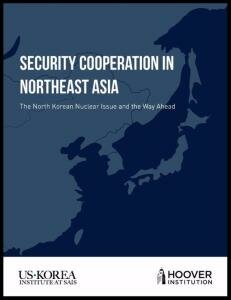
North Korea conducted its fifth and most powerful nuclear test in September 2016. It is also making significant progress on its delivery systems, rapidly expanding its stockpile of fissile materials, and steadily improving on its nuclear weapon designs. There is growing concern that if this process continues, North Korea could soon become a clear and present danger not only to Northeast Asia, but also to the United States.
With this in mind, the US-Korea Institute at SAIS partnered with the Hoover Institution at Stanford University to convene some of the leading experts on Northeast Asia security issues to take stock of the issue and consider what steps can be taken to stabilize the situation and halt North Korea’s development of weapons of mass destruction. The two-day conference was held at Stanford University in mid-June and was co-chaired by former Secretary of State George P. Shultz and former Secretary of Defense William J. Perry.
The following report is a summary of the main points discussed by the participants, with the primary takeaway that there is a need for a comprehensive policy review along the lines of the “Perry Process” fifteen years ago.
Download the report, “Security Cooperation in Northeast Asia: The North Korean Nuclear Issue and the Way Ahead”
38 North Publishes New Article
From Pluto to Pyongyang, and Back with commentary by James Church.
“In 2006, Pluto was downgraded from a planet to a dwarf planet, failing to meet all the criteria of a (then) newly established definition of planet. These days, some should like to do the same with North Korea…” Click here to read the full article.
38 North Publishes New Article
As US-DPRK relations continue to deteriorate, Robert Carlin encourages more careful analysis and commitment when navigating North Korea’s signals. Read the latest at USKI’s 38 North.
One Korea Forum
Wednesday, Jul 13, 2016 – One Korea Forum
One Korea Forum
One Korea Forum
The Power of Freedom in Addressing the Divided Korean Family
Empowering the Voice of North Korean Defectors
Wednesday, July 13, 2016
10:00 AM – 12:00 PM
Johns Hopkins SAIS, Kenney Auditorium
1740 Massachusetts Ave, NW
Washington, DC 20036
To RSVP or learn more about this event, please visit: https://uskoreainstitute.org/events/OneKoreaForum
Click here to watch the webcast
The U.S.-Korea Institute at SAIS, The Paul H. Nitze School of Advanced International Studies, Johns Hopkins University