Published on July 17, 2013
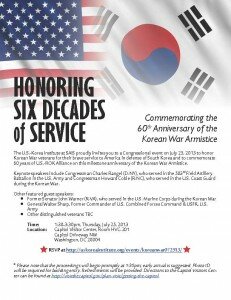 The U.S.-Korea Institute at SAIS proudly invites you to a Congressional event on July 25, 2013 to honor Korean War veterans for their brave service to America in defense of South Korea and to commemorate 60 years of U.S.-ROK Alliance on this milestone anniversary of the Korean War Armistice.
Keynote speakers include Congressman Charles Rangel (D-NY), who served in the 503rd Field Artillery Battalion in the U.S. Army and Congressman Howard Coble (R-NC), who served in the U.S. Coast Guard during the Korean War.
Other featured guest speakers:
- Former Senator John Warner (R-VA), who served in the U.S. Marine Corps during the Korean War
- General Walter Sharp, former commander of U.S. Combined Forces Command & U.S. Forces Korea, U.S. Army
- Ray Kapaun, newphew of Father Emil J. Kapaun, a U.S. Army chaplain who died as a POW in the Korean War and a posthumous recipient of the Medal of Honor
- Steven S. Lee, U.S. Navy commander who was the first Korean American graduate of the U.S. Naval Academy to command at sea (former commander of the USS Gonzalez)
Time: 1:30-3:30pm, Thursday, July 25, 2013
Location: Capitol Visitor Center, Room HVC-201
To RSVP for this event, click here.
* Please note that the proceedings will begin promptly at 1:30pm; early arrival is suggested. Photo ID will be required for building entry. Refreshments will be provided. Directions to the Capitol Visitor Center can be found at http://visitthecapitol.gov/plan-visit/getting-the-capitol.
Published on June 25, 2013
NEWS RELEASE
Contact: Felisa Neuringer Klubes
202.663.5626
Former U.S. Ambassador to South Korea Stephen Bosworth Named Chairman of the U.S.-Korea Institute at SAIS
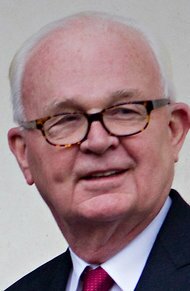
Ambassador Stephen Bosworth, Chairman, U.S.-Korea Institute at SAIS (Photo: Anja Niedringhaus/AP)
Washington, D.C.—June 25, 2013— Stephen Bosworth, former U.S. ambassador to the Republic of Korea, will join the Johns Hopkins University Paul H. Nitze School of Advanced International Studies (SAIS) as the new chairman of the U.S.-Korea Institute (USKI) at SAIS, effective July 1.
Bosworth recently retired as dean of Tufts University’s Fletcher School of Law and Diplomacy, a position he assumed in 2001 after a long and distinguished career in the U.S. Department of State.
“Ambassador Bosworth is one of America’s most distinguished diplomats with deep knowledge of Korea, its global role and regional interests. He will be a valuable addition to SAIS’s Korean Studies Program and the U.S.-Korea Institute’s critical work on Korea and Asia,” said SAIS Dean Vali Nasr.
During his 30 years in the foreign service, Bosworth served as U.S. ambassador to Tunisia, the Philippines and the Republic of Korea as well as director of Policy Planning at the State Department. After leaving the government, Bosworth was president of the United States-Japan Foundation from 1987 to 1995 and the executive director of the Korean Peninsula Energy Development Organization from 1995 to 1997. He also served as the U.S. Special Representative for North Korea Policy for the Obama administration from 2009 to 2011.
He has authored numerous articles and studies on public policy and international affairs. In 2006, he co-authored with Morton Abramowitz, Chasing the Sun: Rethinking East Asian Policy.
As USKI’s new chairman, Bosworth succeeds Don Oberdorfer, the founder of the institute, who will become chairman emeritus.
read more …
Published on May 2, 2013
The U.S.-Korea Institute at SAIS (USKI) and the Global America Business Institute (GABI) are pleased to invite you to a speaker and discussion series featuring presentations on subjects relevant to the 123 Agreement between the US and South Korea:
Next Discussion
US 123 Agreements: Perspective of the Nuclear Industry
Guest Speaker: Amir Shahkarami, Senior Vice President and CEO, Exelon Nuclear Partners
Amir Shahkarami is Senior Vice President of Exelon Generation Company and CEO of Exelon Nuclear Partners, where he is responsible for all domestic and international business development projects. He has nearly 30 years of experience in the nuclear industry, with ten years at Exelon. Most recently, he was Exelon Nuclear Senior Vice President of Technical Services, in which he was responsible for nuclear fuel, engineering, project management, license renewal, industry organizations, innovation, and Exelon Nuclear’s international exchange program. Prior to joining Exelon, Mr. Shahkarami held several key positions of increasing responsibility at Entergy at several nuclear sites and corporate for ten years. He received his bachelor’s and master’s degrees in Engineering from Tulane University, his MBA from Mississippi College, and his Ph.D. in Nuclear Engineering from Louisiana State University.
Monday, May 13, 2013
2:00 – 3:00pm
Rome Auditorium
1619 Massachusetts Avenue NW,
Washington, DC 20036
RSVP: To register, please contact Alan Ahn at or
202-499-7978
.
Published on November 14, 2012
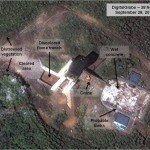 While the North Koreans may have refrained from conducting a nuclear test and subsequent missile tests after their failed rocket launch in April 2012, recent satellite imagery shows that the North is still continuing development of their missile development and the launch pad at the Sohae Satellite Launching Station (Tongchang-ri). USKI’s 38 North was the first to report on these developments, analyzing imagery from DigitalGlobe. According to 38 North analysts, the North has conducted liquid-fueled rocket engine tests at the Sohae facility as recently as September, and has continuing improvements to the Sohae launch pad. Full analysis and satellite imagery can be found here: http://38north.org/2012/11/sohae111212/.
Just after Barack Obama was re-elected to a second term as President of the United States and just a month before a hotly contested presidential race in South Korea, the developments at Sohae have reminded both candidates of why North Korea policy coordination in these new adminstrations is important and of the potential for provocations at the outset of the two Presidents’ terms.
See CNN coverage of the 38 North article here: http://www.cnn.com/video/#/video/world/2012/11/14/clancy-nkorea-rocket-test.cnn.
Published on July 19, 2012
USKI’s 38 North and Stanford University’s Center for International Security and Cooperation (CISAC) have launched new resources on the history of KEDO to help increase public understanding of what this project was and what it accomplished.
When the South Korean fast ferry Hankyoreh sailed out of North Korean waters into the cold wind and waves of the East Sea on the morning of 8 January 2006, it carried a sad and somber group of South Korean workers, ROK officials, and personnel from the Korean Peninsula Energy Development Organization (KEDO). These were all that remained of a decade long multinational effort transforming what in 1994 had been only a paper notion into a modern construction complex of steel and concrete. KEDO’s profile on the North Korean landscape was unmistakable, its impact on Pyongyang profound. Yet, real knowledge and understanding about the organization in public and official circles in South Korea, Japan, and the United States was terribly thin at the beginning, and remains so to this day. ~ A History of KEDO 1994-2006
 In conjunction with the release of CISAC’s new book, A History of KEDO 1994-2006–an oral history project meant to preserve what remains of the living memory about KEDO, of the thinking that went into setting up the organization, the efforts to coordinate plans and translate them to realities on the ground in North Korea, and the struggle to maintain a sense of sanity while KEDO was pushed and pummeled into disintegration–USKI’s 38 North launches a new video: “Reflections on KEDO.” In this video, Joel Wit (38 North founder and Visiting Scholar at the US-Korea Institute at SAIS), hosts a conversation with Ambassador Stephen Bosworth (former US Special Representative for North Korea Policy and current Dean of The Fletcher School at Tufts University) and Robert Carlin (CISAC Visiting Scholar), about their experiences with KEDO. All three were involved with KEDO at different times in its ten year history and provide insights into what it was like on the ground building this multilateral organization. They discuss some of the major challenges in dealing with the North Koreans, as well as the cultural learning curve faced by KEDO’s multicultural staff. From the perspective of direct experience, they examine both KEDO’s accomplishments and the opportunities missed by the organization’s abrupt termination. In the final segment, Ambassador Bosworth also reflects on the Obama administration’s North Korea policy and provides his views on how to improve relations with the North in the future.
My personal conclusion was they [North Koreans] were very serious about what they were doing—the enterprise that we were involved in. This was not something just being done for show. For them, it was not just KEDO and the Agreed Framework and light water reactors, but it was clear for many of them this was important because it was setting a series of precedents for how North Korea could begin to engage with rest of the world in a more direct and active fashion. ~ Ambassador Stephen Bosworth, “Reflections on KEDO,” a 38 North interview
Find the 38 North video here.
Published on March 14, 2012
 The upcoming Nuclear Security Summit (NSS) in Seoul, South Korea, will raise the international profile of the threat of nuclear terrorism and focus attention on the need to better secure weapons-usable nuclear materials in all corners of the globe. It follows the first NSS held in March 2010 in Washington, DC. Another summit will be held in the Netherlands in 2014. This sequencing of biennial, high-level international political summits has underscored the global importance of addressing the threat of nuclear terrorism. As a result, the NSS has the potential to become the preeminent international forum where the state of global nuclear material security is evaluated and where new commitments are made to improve the world’s defenses against nuclear terrorism. But, to fully realize its potential, the NSS process will need to evolve and participating countries must be willing to accept changes that will strengthen the nuclear material security regime.
In this paper, Kenneth Luongo (Partnership for Global Security) outlines the various elements of the current nuclear security regime, and suggests a new and comprehensive architecture that emphasizes demonstrated performance and accountability with clear but flexible standards.
Download “Nuclear Security Governance for the 21st Century: Assessment and Action Plan,” by Kenneth Luongo.
For related papers, visit our Nuclear Security Summit page.