As a complement to the objectives detailed in the 2010 Washington Communiqué and Work Plan, a number of countries made national pledges to take specific measures to improve global nuclear security. These ranged from domestic, unilateral measures to cooperative, multinational contributions that bolster global nuclear security.
In advance of the Seoul Summit, this paper provides an overview of the steps that countries have taken to implement their voluntary, national commitments and demonstrates where needs and gaps of intention remain. The information in this report was obtained primarily from open source publications and is accurate as of February 2012.
The second Nuclear Security Summit (NSS) will be held in Seoul, South Korea, on March 26-27, 2012. This summit, officially named “The 2012 Seoul Nuclear Security Summit,” will be the largest such meeting held in Korea in modern Korean history, just as the 2010 session was the largest summit ever held in Washington, DC.
Dr. Bong-Geun Jun, Director of the Center for Nonproliferation and Nuclear Security at the Institute of Foreign Affairs and National Security (IFANS), discusses South Korean and international efforts to prepare for the 2012 Seoul Nuclear Security Summit and tries to answer key questions about Korea’s role in the NSS process.
As part of our Working Paper Series on the Nuclear Security Summit, Mark Fitzpatrick and Jasper Pandza (International Institute for Strategic Studies) discuss the purpose and progress of the NSS process and possible ways to maintain the momentum built by the process post 2012 in Seoul and 2014 in the Netherlands.
On September 22, 2011, the U.S.-Korea Institute at SAIS, in partnership with Peking University Center for International and Strategic Studies and Chung Ang University Graduate School of International Studies will host a one-day conference exploring the numerous political changes that will take place throughout Asia and the United States in 2012.
Panels will discuss what 2012 leadership may look like for the United States, South Korea, Japan, China, Russia and North Korea, as well as what the effects of these changes might have on regional security and security cooperation in the future.
For a full list of speakers and to RSVP, click here.
On March 29, 2011, the U.S.-Korea Institute and SAIS and Center for the Study of the Presidency and Congress cohosted a seminar entitled, “Leadership Matters: The U.S.-ROK Alliance in the Lead Up to 2012.” The Honorable Lee Jae-oh, South Korea’s Minister of Special Affairs and 4 time National Assemblyman delivered the keynote speech for this event, entitled “Global Leadership: A New Vision for the U.S.-ROK Alliance,” highlighting such key issues the KORUS FTA, coordination on North Korea policy, and his vision for creating a Northeast Asian Community of Peace and Prosperity.
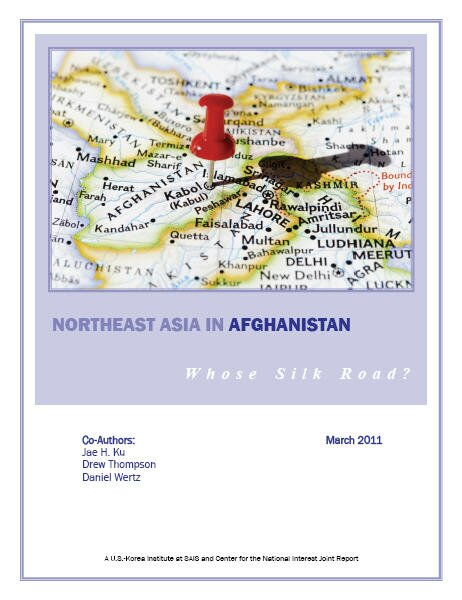
The U.S.-Korea Institute at SAIS and the Center for the National Interest are pleased to announce the release of the joint report “Northeast Asia in Afghanistan: Whose Silk Road?“, co-authored by Jae H. Ku, Drew Thompson, and Daniel Wertz.
This report aims to review Northeast Asian interests in Afghanistan, assess their relevance to the United States’ bilateral relations in the region, and explore potential opportunities for expanded cooperation in the region. It reviews past contributions to Afghan reconstruction made by China, South Korea, and Japan, and analyzes each country’s strategic, economic, and security interests in Afghanistan. By exploring areas of common interest and potential cooperation, it aims to suggest opportunities to expand a multilateral strategy for bringing security and development to Afghanistan in the years ahead.
The research for this paper was generously funded through the U.S.-Korea Institute at SAIS, the Tokyo Foundation, and the China Institute of International Studies. Find out more here.
On November 18, 2010, the U.S.-Korea Institute at SAIS and Korea Institute of Finance, sponsored by the Asian Studies Program at SAIS and JoongAng Ilbo, will host a one-day conference, entitled “State of the World Economy, 2011-2012: Whither or Wither?” in celebration of Korea Institute of Finance’s 20th anniversay, 1991-2011.
This conference will consist of three sessions: Whither the Global Economy; Demand, Deflation, and Debt in the “Locomotive” Economies; and Implications and Future of the Korean Economy; and will feature such noted economists as Kevin O’Rourke, John Taylor, Dan Rosen, Marcus Noland, Roger Leeds, Peter Heller and more. Special addresses will be delivered by the Honorable Han Duk-soo, ROK Ambassador to the United States, and Dr. Chung Duck-koo, Chairman of the North East Asia Research Foundation.
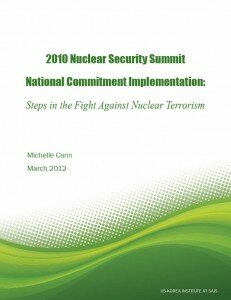 As a complement to the objectives detailed in the 2010 Washington Communiqué and Work Plan, a number of countries made national pledges to take specific measures to improve global nuclear security. These ranged from domestic, unilateral measures to cooperative, multinational contributions that bolster global nuclear security.